Library › Pharmacology › Nonstatin LDL-lowering therapies
Nonstatin LDL-lowering therapies: ezetimibe, PCSK9 inhibitors, inclisiran, and bempedoic acid
Nonstatin LDL-lowering drugs in adults: mechanisms, outcome trials, add-on sequencing under the 2026 ACC/AHA guideline, therapy for homozygous familial hypercholesterolemia, apheresis, safety, and access.
Nonstatin drugs lower low-density lipoprotein cholesterol (LDL-C) by mechanisms that converge on the hepatic LDL receptor, so their effects add to those of a statin. Ezetimibe lowers LDL-C by about 25% on a statin, bempedoic acid by about 18%, inclisiran by about 50%, and a proprotein convertase subtilisin/kexin type 9 (PCSK9) monoclonal antibody by about 55% to 60%. Ezetimibe, evolocumab, alirocumab, and bempedoic acid reduce cardiovascular events in randomized trials. Under the 2026 American College of Cardiology/American Heart Association (ACC/AHA) guideline, adults with clinical atherosclerotic cardiovascular disease (ASCVD) at very high risk who remain above an LDL-C goal of 55 mg/dL on a maximally tolerated statin receive ezetimibe and/or a PCSK9 monoclonal antibody (Class 1).
Where nonstatin therapy fits after maximally tolerated statin therapy
Statins remain the foundation of LDL-lowering therapy because they have the largest body of outcome evidence, low cost, and once-daily oral dosing. Nonstatin therapy enters at three points. A maximally tolerated statin may not reach the LDL-C goal for the patient's risk group. The reduction required from the outset may exceed what any statin can deliver. Statin-attributed side effects may limit or prevent statin use. The term maximally tolerated statin denotes the highest intensity a patient can take without unacceptable side effects. It may be a high-intensity dose, a lower dose, an alternate-day schedule, or no statin at all.
The case for adding a second mechanism rests on the causal role of LDL in atherosclerosis and on a consistent relation between the absolute reduction in LDL-C and the reduction in events. In the Cholesterol Treatment Trialists' (CTT) meta-analysis of 26 statin trials, each 39 mg/dL reduction in LDL-C lowered major vascular events by about one-fifth. The nonstatin outcome trials (IMPROVE-IT with ezetimibe, FOURIER and VESALIUS-CV with evolocumab, ODYSSEY OUTCOMES with alirocumab, and CLEAR Outcomes with bempedoic acid) produced event reductions consistent with that relation. The benefit therefore follows the LDL-C reduction, whatever the drug that produces it.
All of the widely used agents raise LDL receptor activity on hepatocytes. Statins and bempedoic acid reduce hepatic cholesterol synthesis at two different enzymatic steps. Ezetimibe and bile acid sequestrants reduce the cholesterol delivered to the liver from the intestine. PCSK9 inhibitors, whether antibodies, small interfering RNA, or oral peptides, prevent receptor degradation. Because each acts at a different step, the percentage reductions multiply: each added agent removes a fixed fraction of the LDL-C that remains. Two drugs act independently of the LDL receptor, evinacumab and lomitapide, and they are reserved for homozygous familial hypercholesterolemia (HoFH), in which receptor function is absent or severely reduced.
| Agent | Mechanism | Route and adult dose | Further LDL-C reduction on a statin | Outcome evidence | Principal adverse effects | Cost and access |
|---|---|---|---|---|---|---|
| Ezetimibe | Inhibits the Niemann-Pick C1-Like 1 (NPC1L1) sterol transporter in the intestine | 10 mg orally once daily | About 25% (18% as monotherapy) | IMPROVE-IT after acute coronary syndrome (HR 0.936); SHARP in chronic kidney disease (with simvastatin) | Rare; transaminase elevation with a statin | Generic, inexpensive; fixed-dose combinations with statins and with bempedoic acid |
| Evolocumab | Human monoclonal antibody to circulating PCSK9 | 140 mg every 2 weeks or 420 mg monthly, subcutaneous | About 60% (FOURIER 59%) | FOURIER (HR 0.85); VESALIUS-CV in patients without prior myocardial infarction or stroke (HR 0.75) | Injection-site reactions; rare hypersensitivity | Specialty pharmacy benefit; prior authorization |
| Alirocumab | Human monoclonal antibody to circulating PCSK9 | 75 or 150 mg every 2 weeks, or 300 mg every 4 weeks, subcutaneous | About 45% to 60%, dose-dependent | ODYSSEY OUTCOMES after acute coronary syndrome (HR 0.85) | Injection-site reactions; rare hypersensitivity vasculitis | Specialty pharmacy benefit; prior authorization |
| Inclisiran | Small interfering RNA that silences hepatic PCSK9 synthesis | 284 mg subcutaneous at 0 and 3 months, then every 6 months, given by a clinician | About 50% (48% to 52%) | Outcome trials (ORION-4, VICTORION-2 PREVENT) not reported | Injection-site reactions (8% versus 2%); rare anaphylaxis and angioedema | Usually billed as a medical benefit; prior authorization |
| Bempedoic acid | Liver-activated inhibitor of ATP-citrate lyase | 180 mg orally once daily, alone or with ezetimibe 10 mg | About 17% to 18% (21% to 24% without a statin) | CLEAR Outcomes in statin-intolerant patients (HR 0.87) | Hyperuricemia and gout, cholelithiasis, tendon rupture, small rises in creatinine | Branded; prior authorization common |
| Enlicitide | Oral macrocyclic peptide that blocks PCSK9 binding to the LDL receptor | 20 mg orally once daily, fasting | About 56% to 59% | CORALreef Outcomes in progress | Similar to placebo; diarrhea and dizziness in heterozygous FH | Branded; approved July 2026 |
| Bile acid sequestrants | Bind intestinal bile acids | Cholestyramine 8–16 g, colestipol 2–16 g, colesevelam 3.75 g daily in divided doses | 10% to 27% | Lipid Research Clinics Coronary Primary Prevention Trial (LRC-CPPT; cholestyramine, pre-statin era, primary prevention) | Bloating, constipation; raise triglycerides; bind other drugs | Generic |
| Evinacumab | Monoclonal antibody to angiopoietin-like 3 (ANGPTL3) | 15 mg/kg intravenously every 4 weeks | About 49% in HoFH, independent of LDL receptor function | None; approved for HoFH only | Infusion reactions, anaphylaxis (1%), embryo-fetal toxicity | Specialty infusion; lipid specialist |
| Lomitapide | Inhibits microsomal triglyceride transfer protein | 5 mg orally titrated to a maximum of 60 mg daily | 40% to 50% in HoFH | None; HoFH only | Gastrointestinal effects, hepatic steatosis, transaminase elevation (boxed warning) | Restricted distribution program (REMS) |
Nonstatin LDL-lowering agents available in the United States. Reductions are average placebo-corrected effects from the pivotal trials and the 2026 ACC/AHA guideline (Table 5); individual responses vary. HR, hazard ratio for the primary end point; FH, familial hypercholesterolemia; REMS, Risk Evaluation and Mitigation Strategy.
Four considerations set the order in which these agents are used: the gap between the current LDL-C and the goal, the strength of outcome evidence in the patient's clinical setting, tolerability and route, and access and cost. The 2026 guideline no longer requires that ezetimibe precede a PCSK9 monoclonal antibody, because the antibodies now have extended safety data and lower prices. Ezetimibe remains the usual first addition when the gap is small.
LDL-C goals and thresholds that trigger add-on therapy
The trigger for nonstatin therapy has changed with each US document. The 2018 AHA/ACC multisociety cholesterol guideline used thresholds in clinical ASCVD at very high risk. Adding ezetimibe was reasonable when LDL-C remained 70 mg/dL or higher on a maximally tolerated statin, and a PCSK9 inhibitor was reasonable when LDL-C remained 70 mg/dL or higher on a statin and ezetimibe. The 2022 ACC Expert Consensus Decision Pathway (ECDP) on nonstatin therapies lowered the threshold for patients at very high risk to 55 mg/dL (non-high-density lipoprotein cholesterol [non-HDL-C] 85 mg/dL) and allowed either ezetimibe or a PCSK9 monoclonal antibody as the first addition. The 2026 ACC/AHA multisociety dyslipidemia guideline converts thresholds into treatment goals, keeps percentage reduction alongside them, and grades each add-on recommendation by class.
| Patient group | 2018 guideline: threshold on maximally tolerated statin | 2022 ACC ECDP: threshold for nonstatin therapy | 2026 guideline: LDL-C goal (non-HDL-C goal) |
|---|---|---|---|
| Clinical ASCVD at very high risk | LDL-C ≥70 mg/dL: ezetimibe (2a); then PCSK9 inhibitor (2a) | LDL-C ≥55 mg/dL or non-HDL-C ≥85 mg/dL; ezetimibe or PCSK9 monoclonal antibody first, or both | <55 mg/dL (<85 mg/dL) |
| Clinical ASCVD, not at very high risk | LDL-C ≥70 mg/dL: ezetimibe (2b) | LDL-C ≥70 mg/dL or non-HDL-C ≥100 mg/dL; ezetimibe first, PCSK9 antibody second | <70 mg/dL (<100 mg/dL); optional <55 mg/dL |
| Clinical ASCVD with chronic kidney disease stage 3 or higher | No separate threshold | No separate threshold | <55 mg/dL (<85 mg/dL) |
| LDL-C ≥190 mg/dL without ASCVD | <50% reduction or LDL-C ≥100 mg/dL: ezetimibe (2a); heterozygous FH with LDL-C ≥100 mg/dL on statin and ezetimibe: PCSK9 inhibitor (2b) | <50% reduction or LDL-C ≥100 mg/dL | <100 mg/dL (<130 mg/dL); <70 mg/dL (<100 mg/dL) with FH, risk factors, or coronary calcium |
| Severe hypercholesterolemia or heterozygous FH with clinical ASCVD | As for very high risk | LDL-C ≥55 mg/dL | <55 mg/dL (<85 mg/dL) |
| Diabetes, age 40 to 75, without ASCVD | 10-year risk ≥20%: ezetimibe to reach a ≥50% reduction (2b) | 10-year risk ≥20% with <50% reduction or LDL-C ≥70 mg/dL: ezetimibe | <100 mg/dL; <70 mg/dL with risk factors or diabetes-specific risk modifiers |
| Primary prevention, high risk | No nonstatin recommendation | 10-year risk ≥20% with inadequate response: ezetimibe | PREVENT-ASCVD (Predicting Risk of cardiovascular disease EVENTs) ≥10%: <70 mg/dL (<100 mg/dL) |
| Coronary artery calcium (CAC) score 1,000 Agatston units or higher | Not addressed | <50% reduction or LDL-C ≥70 mg/dL on statin and ezetimibe: PCSK9 antibody | <55 mg/dL (<85 mg/dL) |
Evolution of US triggers for nonstatin therapy. The 2026 goals are summarized from the guideline's Figure 1; the full goal table, the very-high-risk definition, and the trial basis for goals are covered in LDL-C goals in dyslipidemia and LDL lowering. Class of recommendation in parentheses.
Very high risk. In the 2026 guideline, clinical ASCVD at very high risk means two or more major ASCVD events (acute coronary syndrome within 12 months, other myocardial infarction, ischemic stroke, symptomatic peripheral artery disease). It also includes one major event with two or more high-risk conditions (age 65 years or older, prior coronary artery bypass surgery or percutaneous coronary intervention, current smoking, diabetes, hypertension, heart failure, or LDL-C of 100 mg/dL or higher despite a maximally tolerated statin and ezetimibe). The guideline states that most patients with clinical ASCVD meet this definition. Diabetes and polyvascular disease place many patients in the very-high-risk group and are settings in which absolute benefit from added LDL lowering is large. Chronic kidney disease is not a criterion, but clinical ASCVD with stage 3 or higher chronic kidney disease carries the same goal below 55 mg/dL (Class 1). In FOURIER, patients with diabetes had a similar relative risk reduction to those without (primary end point HR 0.83 and 0.87, respectively) but a larger absolute benefit because of their higher baseline risk. Symptomatic peripheral artery disease is itself a major ASCVD event, and its management is covered in peripheral artery disease.
Percentage reduction and absolute goals. A high-intensity statin is expected to lower LDL-C by 50% or more. Failure to achieve that reduction points to nonadherence, an inadequate dose, or a genetic cause of poor response, and it is assessed before a nonstatin is added. Once the statin response is confirmed, the absolute goal determines whether more therapy is needed.
Risk enhancers and imaging. In primary prevention, the decision to escalate beyond a statin is informed by the same tools that personalize the decision to start one. A CAC score of 300 to 999 Agatston units makes intensification to a goal below 55 mg/dL reasonable (Class 2a), and a score of 1,000 or more sets the goal below 55 mg/dL. Apolipoprotein B (apoB) measurement is reasonable (Class 2a) to guide intensification once LDL-C and non-HDL-C goals are met, particularly with elevated triglycerides, diabetes, cardiovascular-kidney-metabolic syndrome, or ASCVD; apoB counts atherogenic particles and identifies residual risk that LDL-C understates. Lipoprotein(a) of 125 nmol/L (50 mg/dL) or more is a risk enhancer. In clinical ASCVD with elevated lipoprotein(a) and LDL-C above goal on a maximally tolerated statin, the guideline recommends adding a PCSK9 monoclonal antibody with proven cardiovascular benefit (Class 1). PREVENT risk estimation, CAC thresholds, and risk enhancers are covered in cardiovascular risk assessment and coronary CT angiography and calcium scoring.
European guidance. The 2019 European Society of Cardiology/European Atherosclerosis Society (ESC/EAS) guideline sets an LDL-C goal below 55 mg/dL with at least a 50% reduction for all patients at very high risk, a category that includes every patient with clinical ASCVD. The 2025 focused update left the goals unchanged and added bempedoic acid as a Class I option in statin intolerance and as a Class IIa addition to a statin with or without ezetimibe in high- and very-high-risk patients.
Ezetimibe: NPC1L1 inhibition, IMPROVE-IT, and combination pills
Mechanism and pharmacokinetics. Ezetimibe binds Niemann-Pick C1-Like 1, the sterol transporter on the brush border of jejunal enterocytes and on the canalicular membrane of hepatocytes. It blocks absorption of dietary and biliary cholesterol and of plant sterols. Less cholesterol reaches the liver in chylomicron remnants, hepatic sterol content falls, and the sterol regulatory element-binding protein 2 (SREBP-2) pathway increases LDL receptor expression. Statins inhibit synthesis and provoke a compensatory rise in intestinal cholesterol absorption, and ezetimibe blocks that rise; the two mechanisms are complementary. After absorption, ezetimibe is glucuronidated in the intestinal wall and liver to an active glucuronide, which undergoes enterohepatic recirculation. Ezetimibe and its glucuronide each have a half-life of about 22 hours, which supports once-daily dosing at any time of day, with or without food. Elimination is mainly fecal, and ezetimibe is not metabolized to a clinically important extent by cytochrome P450 enzymes.
LDL-C lowering. In the pooled 12-week monotherapy trials in the US prescribing information, ezetimibe 10 mg lowered LDL-C by about 18%. Added to a statin, it produces an incremental reduction of about 25% (the figure used in the 2026 guideline), larger than the roughly 6% obtained by doubling the statin dose. The effect is measured from 4 weeks onward. Ezetimibe is also the drug of choice for sitosterolemia, a recessive disorder of sterol efflux in which plant sterol absorption is unregulated.
IMPROVE-IT. IMPROVE-IT randomized 18,144 patients within 10 days of hospitalization for acute coronary syndrome to simvastatin 40 mg with ezetimibe 10 mg or simvastatin 40 mg with placebo. Eligibility required LDL-C of 50 to 100 mg/dL on lipid-lowering therapy, or 50 to 125 mg/dL without it. The median time-weighted LDL-C was 53.7 versus 69.5 mg/dL. Median follow-up was 6 years. The primary composite of cardiovascular death, myocardial infarction, unstable angina requiring rehospitalization, coronary revascularization after 30 days, or stroke occurred in 32.7% versus 34.7% at 7 years (absolute difference 2.0 percentage points; HR 0.936; 95% confidence interval [CI] 0.89–0.99). Muscle, gallbladder, hepatic, and cancer events did not differ. IMPROVE-IT was the first trial to show that a nonstatin mechanism of LDL lowering reduces events. The size of the benefit matched the reduction predicted by the statin trials for the LDL-C difference achieved. A secondary analysis described in the 2026 guideline found the absolute benefit concentrated in patients with three or more of nine high-risk indicators (absolute risk reduction 6.3%).
Kidney disease, older adults, and moderate-intensity combinations. The Study of Heart and Renal Protection (SHARP) randomized 9,270 patients with chronic kidney disease, 3,023 of them on dialysis, to simvastatin 20 mg with ezetimibe 10 mg or placebo. An average LDL-C difference of 33 mg/dL produced a 17% reduction in first major atherosclerotic events (11.3% versus 13.4%; rate ratio 0.83), with no excess myopathy, hepatitis, gallstones, or cancer. The trial found no good evidence that the proportional effect differed between patients on dialysis and those not on dialysis, although the absolute effect in dialysis patients was small. EWTOPIA 75, an open-label Japanese trial in 3,796 adults aged 75 or older with elevated LDL-C and no coronary disease, reported fewer primary events with ezetimibe than with usual care (HR 0.66; 95% CI 0.50–0.86). Premature termination and protocol deviations limit the estimate. In RACING, 3,780 Korean patients with ASCVD received rosuvastatin 10 mg with ezetimibe or rosuvastatin 20 mg alone. The combination was noninferior for the 3-year composite end point (9.1% versus 9.9%). More patients reached LDL-C below 70 mg/dL (72% to 75% versus 55% to 60%), and intolerance-related discontinuation or dose reduction was less frequent (4.8% versus 8.2%). RACING supports a moderate-intensity statin with ezetimibe as an alternative when a high-intensity dose is not tolerated.
Safety and interactions. Ezetimibe is among the best-tolerated cardiovascular drugs. Consecutive transaminase elevation to three times the upper limit of normal or more is slightly more frequent with ezetimibe plus a statin than with a statin alone (1.3% versus 0.4%). Liver enzymes are tested as clinically indicated, and ezetimibe is withdrawn if the elevation persists. Cyclosporine raises ezetimibe exposure (area under the curve about 240% higher) and ezetimibe raises cyclosporine levels, so cyclosporine concentrations are monitored. Fenofibrate raises total ezetimibe exposure by about 48% and gemfibrozil by about 64%; the label recommends against combination with fibrates other than fenofibrate, and gallbladder studies are indicated if gallstones are suspected. Cholestyramine lowers ezetimibe exposure by about 55%, so ezetimibe is taken at least 2 hours before or 4 hours after a bile acid sequestrant. Ezetimibe is not recommended in moderate or severe hepatic impairment (Child-Pugh B or C) and needs no dose adjustment for kidney function.
Combination pills. Fixed-dose combinations of ezetimibe with simvastatin, and of ezetimibe 10 mg with bempedoic acid 180 mg, are marketed in the United States; the rosuvastatin-ezetimibe and atorvastatin-ezetimibe tablets have been discontinued. A single tablet lowers pill burden and improves persistence, and the 2026 guideline supports starting combination therapy when the reduction required exceeds what a statin alone can deliver. In a secondary-prevention meta-analysis cited by the guideline, early combination therapy improved LDL-C lowering and cardiovascular outcomes compared with statin monotherapy, with similar tolerability.
PCSK9 biology and the genetics of PCSK9 inhibition
Proprotein convertase subtilisin/kexin type 9 (PCSK9) is a serine protease made mainly by hepatocytes. After autocatalytic cleavage, the prodomain remains bound to the catalytic domain, and the protein is secreted without protease activity toward other substrates. Circulating PCSK9 binds the epidermal growth factor-like repeat A (EGF-A) domain of the LDL receptor at the cell surface. The PCSK9-receptor complex is internalized with its LDL particle. In the acidic endosome, PCSK9 binds the receptor more tightly; the receptor cannot adopt the closed conformation needed to release its ligand and return to the surface, and it is routed to the lysosome for degradation. Without PCSK9, each receptor recycles many times. PCSK9 therefore sets the number of LDL receptors on the hepatocyte surface and, through them, the plasma LDL-C concentration.
PCSK9 transcription is driven by SREBP-2, the same transcription factor that statins activate. Statins therefore raise circulating PCSK9, which partly offsets the receptor upregulation they produce and contributes to the flat dose-response of statins (about 6% more LDL-C lowering per doubling of dose). Blocking PCSK9 removes this brake, which is why PCSK9 inhibitors are most effective on a statin background.
Human genetics validated PCSK9 as a drug target before any drug existed. Gain-of-function variants in PCSK9 cause an autosomal dominant hypercholesterolemia that is clinically indistinguishable from familial hypercholesterolemia caused by LDLR or APOB variants. In the Atherosclerosis Risk in Communities study, the 2.6% of Black participants who carried nonsense variants in PCSK9 had 28% lower mean LDL-C and an 88% lower risk of coronary heart disease over 15 years (HR 0.11). The 3.2% of White participants who carried the R46L variant had 15% lower LDL-C and a 50% lower risk of coronary heart disease (HR 0.50; 95% CI 0.32 to 0.79). A later meta-analysis of 66,698 participants found 12% lower LDL-C and a 28% lower risk of ischemic heart disease in R46L carriers (HR 0.72; 95% CI 0.62 to 0.84). The disproportionately large risk reduction relative to the LDL-C difference reflects lifelong exposure, the principle that the cumulative burden of LDL-C over time determines atherosclerotic risk.
Mendelian randomization comparing variants in PCSK9 and in HMGCR (the gene for 3-hydroxy-3-methylglutaryl coenzyme A [HMG-CoA] reductase) found nearly identical protection against cardiovascular events per 10 mg/dL lower LDL-C (odds ratio 0.81 for each). The small increases in diabetes risk were also nearly identical (odds ratio 1.11 and 1.13) and confined to persons with impaired fasting glucose. The genetic data predict that PCSK9 inhibition reduces events in proportion to LDL lowering, as statins do, with a small glycemic signal. In FOURIER, evolocumab did not increase new-onset diabetes or worsen glycemia over a median of 2.2 years, including among the 10,344 participants with prediabetes.
PCSK9 inhibition can be achieved at four levels. Monoclonal antibodies bind the circulating protein. Inclisiran and, in development, permanent gene editing prevent hepatic synthesis. The oral peptide enlicitide blocks the PCSK9-receptor interaction. Oral small molecules in development stabilize PCSK9 so that it no longer directs the receptor to the lysosome.
PCSK9 monoclonal antibodies: evolocumab and alirocumab
Evolocumab and alirocumab are fully human IgG monoclonal antibodies that bind free PCSK9 in plasma and prevent its binding to the LDL receptor. Both are self-administered subcutaneously by prefilled pen or syringe. Their elimination is partly target-mediated: at low concentrations, binding to PCSK9 accelerates clearance, while at higher concentrations the nonsaturable reticuloendothelial pathway predominates. The effective half-life is about 11 to 17 days for evolocumab and 17 to 20 days for alirocumab. Neither is metabolized by cytochrome P450 enzymes or transported by drug transporters, and neither has clinically important pharmacokinetic interactions.
| Feature | Evolocumab | Alirocumab |
|---|---|---|
| Adult dose for hypercholesterolemia and cardiovascular risk reduction | 140 mg every 2 weeks or 420 mg once monthly; the two regimens are clinically equivalent | 75 mg every 2 weeks or 300 mg every 4 weeks, increased to 150 mg every 2 weeks if the response is inadequate |
| HoFH | 420 mg monthly, increased to 420 mg every 2 weeks if the response at 12 weeks is inadequate | 150 mg every 2 weeks |
| On lipoprotein apheresis | 420 mg every 2 weeks, given after the session, may be started to match the apheresis schedule | 150 mg every 2 weeks in heterozygous FH on apheresis, independent of the timing of the session |
| Labeled cardiovascular indication | Reduce major adverse cardiovascular events (including ischemia-driven arterial revascularization) in adults at increased risk, a label revised in October 2026 after VESALIUS-CV | Reduce major adverse cardiovascular events in adults at increased risk |
| Outcome trials | FOURIER (stable ASCVD), VESALIUS-CV (no prior myocardial infarction or stroke) | ODYSSEY OUTCOMES (1 to 12 months after acute coronary syndrome) |
| Anti-drug antibodies | Binding antibodies 0.3%, no neutralizing antibodies | 5.5% anti-drug antibodies and 0.5% neutralizing antibodies in the cardiovascular outcomes population |
| Missed dose | Given within 7 days; after 7 days, the next scheduled every-2-week dose, or a monthly dose given at once with a new monthly schedule | Given within 7 days; after 7 days, the next scheduled dose |
| Timing of LDL-C measurement | From 4 weeks; just before the next dose on the 420 mg monthly regimen | From 4 weeks; just before the next dose on the 300 mg monthly regimen, because levels can rise between doses |
Evolocumab and alirocumab compared, from the US prescribing information (Repatha revised 10/2026; Praluent revised 10/2025). Device-related latex sensitivity applies to some evolocumab syringe and autoinjector presentations.
FOURIER. FOURIER randomized 27,564 patients with clinical ASCVD (prior myocardial infarction, nonhemorrhagic stroke, or symptomatic peripheral artery disease) and LDL-C of 70 mg/dL or more on a statin to evolocumab or placebo. Evolocumab lowered LDL-C by 59%, from a median of 92 to 30 mg/dL. Over a median of 2.2 years, the primary end point (cardiovascular death, myocardial infarction, stroke, hospitalization for unstable angina, or coronary revascularization) occurred in 9.8% versus 11.3% (HR 0.85; 95% CI 0.79–0.92). The key secondary end point (cardiovascular death, myocardial infarction, or stroke) occurred in 5.9% versus 7.4% (HR 0.80; 95% CI 0.73–0.88). Benefit was consistent in the lowest quartile of baseline LDL-C (median 74 mg/dL). Cardiovascular death did not differ during the short trial. The relative risk reduction for the key secondary end point grew from 16% in the first year to 25% beyond the first year, the time course expected when LDL lowering slows plaque progression. Patients with a myocardial infarction within 2 years, two or more prior infarctions, or residual multivessel disease had absolute risk reductions above 3% at 3 years.
FOURIER-OLE. In the open-label extension, 6,635 FOURIER participants received evolocumab for a further median of 5.0 years, with maximum exposure of 8.4 years. Median LDL-C at 12 weeks was 30 mg/dL, and 63.2% of patients had LDL-C below 40 mg/dL. Rates of serious adverse events, muscle events, new-onset diabetes, hemorrhagic stroke, and neurocognitive events did not exceed those of the placebo group in the parent trial and did not rise over time. Patients originally randomized to evolocumab had fewer events during the extension than those switched from placebo, including a 23% lower risk of cardiovascular death (HR 0.77; 95% CI 0.60–0.99). The difference reflects the cost of a 2.2-year delay in therapy and supports early initiation.
ODYSSEY OUTCOMES. ODYSSEY OUTCOMES randomized 18,924 patients 1 to 12 months after acute coronary syndrome, with LDL-C of 70 mg/dL or more, non-HDL-C of 100 mg/dL or more, or apoB of 80 mg/dL or more on a high-intensity or maximally tolerated statin, to alirocumab or placebo. Alirocumab started at 75 mg every 2 weeks and was titrated under blinded conditions to target LDL-C of 25 to 50 mg/dL, with blinded substitution of placebo when LDL-C fell below 15 mg/dL. Over a median of 2.8 years, the primary end point (coronary heart disease death, nonfatal myocardial infarction, ischemic stroke, or unstable angina requiring hospitalization) occurred in 9.5% versus 11.1% (HR 0.85; 95% CI 0.78–0.93). All-cause death occurred in 3.5% versus 4.1% (HR 0.85; 95% CI 0.73–0.98), a nominal result under the trial's hierarchical testing. Absolute benefit was largest in patients with baseline LDL-C of 100 mg/dL or more.
VESALIUS-CV. VESALIUS-CV tested evolocumab 140 mg every 2 weeks in 12,257 patients with atherosclerosis or diabetes, without a prior myocardial infarction or stroke, and with LDL-C of at least 90 mg/dL. Over a median of 4.6 years, the first co-primary end point (coronary heart disease death, myocardial infarction, or ischemic stroke) occurred in 6.2% versus 8.0% at 5 years (HR 0.75; 95% CI 0.65–0.86). The second co-primary end point, which adds ischemia-driven arterial revascularization, occurred in 13.4% versus 16.2% (HR 0.81; 95% CI 0.73–0.89). Safety events were not increased. VESALIUS-CV was published after the 2026 guideline went to press; the guideline had described primary-prevention outcome data for the antibodies as pending. The trial extends PCSK9 antibody benefit to first events in high-risk patients and underlies the broader evolocumab label.
Plaque regression. In GLAGOV, 968 statin-treated patients with angiographic coronary disease received evolocumab 420 mg monthly or placebo for 76 weeks. Time-weighted LDL-C was 36.6 versus 93.0 mg/dL; percent atheroma volume on intravascular ultrasound fell by 0.95% with evolocumab and rose by 0.05% with placebo, and 64.3% versus 47.3% of patients showed regression. In PACMAN-AMI, alirocumab 150 mg every 2 weeks was begun within 24 hours of primary percutaneous coronary intervention for myocardial infarction, on rosuvastatin 20 mg. It reduced percent atheroma volume in non-infarct arteries (−2.13% versus −0.92%) and lipid core burden, and it increased minimal fibrous cap thickness on optical coherence tomography. Regression and stabilization of nonculprit plaque provide a mechanism for the early-initiation benefit seen in the outcome trials.
Lipoprotein(a). PCSK9 antibodies lower lipoprotein(a) by about one-quarter (median 26.9% with evolocumab in FOURIER). In FOURIER, patients with baseline lipoprotein(a) above the median had a 23% relative reduction in coronary heart disease death, myocardial infarction, or urgent revascularization with evolocumab (HR 0.77) and an absolute reduction of 2.49% at 3 years, against a 7% relative reduction (HR 0.93) below the median. These observations underlie the Class 1 recommendation for a PCSK9 antibody in clinical ASCVD with elevated lipoprotein(a) and LDL-C above goal. Testing and specific management of elevated lipoprotein(a) are covered in lipoprotein(a) in dyslipidemia and LDL lowering.
Response in familial hypercholesterolemia. PCSK9 antibodies work by preserving LDL receptors, so their effect depends on residual receptor function. In heterozygous FH, the LDL-C reduction is similar to that in other patients, about 60% with evolocumab. In HoFH, the placebo-corrected reduction is about 31% with evolocumab (TESLA Part B) and 36% with alirocumab (ODYSSEY HoFH), and patients with two null LDLR alleles have a minimal or absent response.
Adverse effects and immunogenicity. Injection-site reactions (erythema, pain, bruising) are the only adverse effect consistently more frequent than with placebo: 2.1% versus 1.6% in FOURIER and 3.8% versus 2.1% in ODYSSEY OUTCOMES. Hypersensitivity reactions, including angioedema and, with alirocumab, hypersensitivity vasculitis, are rare; a prior serious hypersensitivity reaction is the only contraindication. Myalgia, new-onset diabetes, neurocognitive events, and hemorrhagic stroke were not increased in the outcome trials. Anti-drug antibodies against these fully human antibodies are infrequent and have not affected efficacy. Bococizumab differed. It was a humanized antibody that retained murine sequences. In the SPIRE program, which randomized 27,438 patients, high rates of anti-drug antibodies attenuated and varied its LDL-lowering effect, and the trials ended early after a median of 10 months when the sponsor stopped development.
Inclisiran: small interfering RNA with twice-yearly dosing
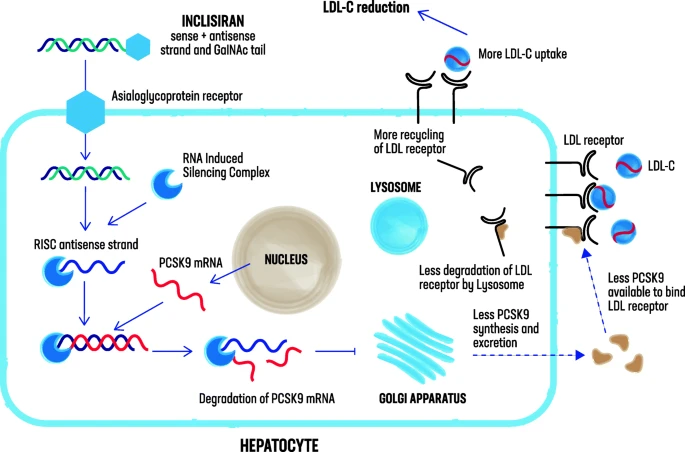

Mechanism. Inclisiran is a chemically stabilized, double-stranded small interfering RNA (siRNA) conjugated to triantennary N-acetylgalactosamine (GalNAc). GalNAc binds the asialoglycoprotein receptor, which is expressed almost exclusively on hepatocytes, so the drug is taken up by the liver within hours of injection and plasma concentrations fall quickly. Inside the hepatocyte, the antisense (guide) strand is loaded into the RNA-induced silencing complex, which binds complementary PCSK9 messenger RNA and cleaves it through Argonaute-2. Because the complex is catalytic and the loaded guide strand persists for months, a single injection suppresses PCSK9 synthesis for about 6 months. Inclisiran lowers intracellular and circulating PCSK9; the antibodies lower only the free circulating protein. The pharmacodynamic effect outlasts the drug's presence in plasma, and inclisiran has no cytochrome P450 or transporter interactions.
Dosing. The dose is 284 mg (equivalent to 300 mg inclisiran sodium) by subcutaneous injection, given by a health care professional, at day 0, at 3 months, and every 6 months thereafter. A dose missed by less than 3 months is given and the original schedule resumes; a dose missed by more than 3 months restarts the schedule with a dose at once and another 3 months later. No adjustment is needed in mild, moderate, or severe renal impairment or in mild to moderate hepatic impairment; the drug has not been studied in end-stage kidney disease or severe hepatic impairment. Because the antibodies and inclisiran act on the same pathway, the 2022 ECDP specifies that inclisiran replaces a PCSK9 antibody and is not added to one.
ORION trials. ORION-10 enrolled 1,561 patients with ASCVD and ORION-11 enrolled 1,617 patients with ASCVD or a risk equivalent, all on a maximally tolerated statin, with mean baseline LDL-C near 105 mg/dL. At day 510, inclisiran lowered LDL-C by 52.3% and 49.9% relative to placebo, with time-adjusted reductions between day 90 and day 540 of 53.8% and 49.2%. ORION-9 enrolled 482 adults with heterozygous FH and a mean baseline LDL-C of 153 mg/dL; the placebo-corrected reduction at day 510 was 47.9 percentage points, with reductions across all genotypes. Injection-site adverse events were more frequent with inclisiran (2.6% versus 0.9% in ORION-10 and 4.7% versus 0.5% in ORION-11) and were mild. In a prespecified exploratory patient-level analysis of the three phase 3 trials, major adverse cardiovascular events occurred in 7.1% versus 9.4% (odds ratio 0.74; 95% CI 0.58–0.94); the trials were not designed to test outcomes.
Implementation and first-line use. VICTORION-INITIATE randomized 450 US patients with ASCVD and LDL-C of 70 mg/dL or more on a maximally tolerated statin to an "inclisiran first" strategy or usual care. LDL-C fell by 60.0% versus 7.0% at day 330; 81.8% versus 22.2% reached LDL-C below 70 mg/dL, and 71.6% versus 8.9% reached LDL-C below 55 mg/dL. Statin discontinuation was 6.0% versus 16.7%, which did not support the concern that an injectable add-on would lead patients to stop statins. Injection-site reactions occurred in 10.3% of the inclisiran group. In VICTORION-Mono, inclisiran monotherapy lowered LDL-C more than ezetimibe or placebo in adults without ASCVD at low 10-year risk who were not taking lipid-lowering therapy. In July 2025, the US label was revised to allow use as monotherapy with diet and exercise. The current label covers adults with hypercholesterolemia.
Outcome trials and guideline position. ORION-4 (about 15,000 patients with established cardiovascular disease, median follow-up of 5 years) and VICTORION-2 PREVENT (established ASCVD; estimated primary completion in 2027) test whether inclisiran reduces cardiovascular events, and VICTORION-1 PREVENT tests primary prevention. None has reported. Pending these results, the 2026 guideline calls inclisiran a second-line PCSK9 inhibitor: in very-high-risk ASCVD it is reasonable (Class 2a) for patients unable to tolerate or obtain evolocumab or alirocumab, or with a strong preference for less frequent dosing. It is also reasonable (Class 2a) in severe hypercholesterolemia with LDL-C of 100 mg/dL or more despite a maximally tolerated statin with or without ezetimibe. It is also reasonable (Class 2a) in clinical ASCVD with statin-attributed muscle symptoms when goals are not met on bempedoic acid with or without ezetimibe. Evidence on inclisiran in HoFH is conflicting, and the guideline makes no recommendation for that group.
Bempedoic acid and CLEAR Outcomes in statin intolerance
Mechanism. Bempedoic acid is an oral prodrug. It is converted to its active coenzyme A thioester by very-long-chain acyl-CoA synthetase 1 (ACSVL1), an enzyme expressed in the liver and essentially absent from skeletal muscle. The active form inhibits ATP-citrate lyase, the enzyme that supplies cytosolic acetyl-CoA for cholesterol and fatty acid synthesis, two steps upstream of HMG-CoA reductase. Hepatic cholesterol synthesis falls, SREBP-2 is activated, and LDL receptors are upregulated. Because the drug is not activated in muscle, it does not reproduce the muscle effects attributed to statins. Bempedoic acid also lowers high-sensitivity C-reactive protein by about one-fifth. The dose is 180 mg once daily with or without food, alone or as a fixed-dose combination with ezetimibe 10 mg, and LDL-C is checked 8 to 12 weeks after starting.
The CLEAR program. CLEAR Harmony randomized 2,230 patients with ASCVD, heterozygous FH, or both on a maximally tolerated statin; bempedoic acid lowered LDL-C by 18.1 percentage points more than placebo at 12 weeks. Overall adverse events did not differ (78.5% versus 78.7%), and gout (1.2% versus 0.3%) and discontinuation for adverse events (10.9% versus 7.1%) were more frequent. CLEAR Wisdom, in 779 high-risk patients on maximally tolerated lipid-lowering therapy, found a 17.4 percentage-point placebo-corrected reduction. CLEAR Serenity randomized 345 patients intolerant of at least two statins (one at the lowest available dose); the placebo-corrected reduction was 21.4%, and myalgia occurred in 4.7% with bempedoic acid and 7.2% with placebo. In a fixed-dose combination trial on maximally tolerated statin therapy, LDL-C fell at 12 weeks by 36.2% with bempedoic acid and ezetimibe combined, by 23.2% with ezetimibe alone, and by 17.2% with bempedoic acid alone, and rose by 1.8% with placebo; the placebo-corrected difference for the combination was −38.0 percentage points.
CLEAR Outcomes. CLEAR Outcomes randomized 13,970 patients who were unable or unwilling to take statins because of adverse effects, and who had or were at high risk for cardiovascular disease, to bempedoic acid 180 mg or placebo. Mean baseline LDL-C was 139.0 mg/dL. At 6 months, LDL-C was 29.2 mg/dL lower with bempedoic acid, a difference of 21.1 percentage points. Over a median of 40.6 months, the four-component primary end point (cardiovascular death, nonfatal myocardial infarction, nonfatal stroke, or coronary revascularization) occurred in 11.7% versus 13.3% (HR 0.87; 95% CI 0.79–0.96). Fatal or nonfatal myocardial infarction (3.7% versus 4.8%; HR 0.77) and coronary revascularization (6.2% versus 7.6%; HR 0.81) were reduced, whereas stroke, cardiovascular death, and all-cause death were not. The event reduction matched the CTT expectation for a 29 mg/dL reduction in LDL-C.
Primary prevention in CLEAR Outcomes. The primary prevention cohort comprised 4,206 statin-intolerant patients without a prior event (mean age 68 years, 59% women, 66% with diabetes). LDL-C fell by 30.2 mg/dL (21.3%) and high-sensitivity C-reactive protein by 21.5%. The primary end point occurred in 5.3% versus 7.6% (adjusted HR 0.70; 95% CI 0.55–0.89), with lower rates of cardiovascular death (HR 0.61) and all-cause death (HR 0.73). Bempedoic acid is the first nonstatin with outcome data in high-risk primary prevention. Since March 2024, its US label has included cardiovascular risk reduction in adults who are unable to take recommended statin therapy, with or without established cardiovascular disease.
Adverse effects and laboratory changes. Bempedoic acid inhibits renal organic anion transporter 2 (OAT2), which reduces uric acid excretion and raises serum uric acid by a mean of 0.8 mg/dL.
| Effect | Hypercholesterolemia trials (bempedoic acid versus placebo) | CLEAR Outcomes (bempedoic acid versus placebo) | Clinical handling |
|---|---|---|---|
| Hyperuricemia | 26% versus 9.5% (normal baseline); clinically significant 3.5% versus 1.1% | Clinically significant 16.4% versus 8.2% | Uric acid measured at baseline and during therapy; urate-lowering treatment as indicated |
| Gout | 1.5% versus 0.4% | 3.2% versus 2.2% (label); 3.1% versus 2.1% (trial report) | Highest risk with prior gout; not a contraindication |
| Tendon rupture | 0.5% versus 0% | 1.2% versus 0.9% | Higher risk over age 60, with corticosteroids or fluoroquinolones, renal failure, or prior tendon disorders; an alternative is preferred with prior tendon disorders or rupture, and the drug is stopped at the first sign of rupture |
| Cholelithiasis | Not separately reported | 2.2% versus 1.2% | Biliary symptoms evaluated |
| Serum creatinine rise ≥0.5 mg/dL | 2.2% versus 1.1% (mean rise 0.05 mg/dL) | 7.1% versus 5.5% | Reversible; reflects tubular transporter inhibition |
| Doubling of blood urea nitrogen | 3.8% versus 1.5% | 9.5% versus 6.2% | Interpreted with creatinine |
| Hemoglobin fall ≥2 g/dL below normal | 5.1% versus 2.3% | 10.8% versus 7.4% | Hemoglobin rechecked if symptomatic |
| Aspartate aminotransferase >3 times normal | 1.4% versus 0.4% | Repeated ALT or AST >3 times normal: 1.6% versus 1.0% | Usually asymptomatic and reversible |
Adverse effects and laboratory changes with bempedoic acid from the US prescribing information (Nexletol, revised 1/2026) and the CLEAR Outcomes report. ALT, alanine aminotransferase; AST, aspartate aminotransferase.
Interactions. Bempedoic acid raises exposure to simvastatin acid and pravastatin acid about 2-fold each. Simvastatin doses above 20 mg and pravastatin doses above 40 mg are avoided during treatment. Bempedoic acid has no clinically important cytochrome P450 interactions.
Guideline position. In very-high-risk ASCVD, adding bempedoic acid to a statin, with or without ezetimibe and/or a PCSK9 antibody, is reasonable (Class 2a, level of evidence [LOE] B-R). The guideline explains the class: CLEAR Outcomes enrolled statin-intolerant patients, and no outcome trial has tested bempedoic acid on top of a statin. In clinical ASCVD with statin-attributed muscle symptoms, a reduced statin dose if tolerated and the addition of bempedoic acid, ezetimibe, or a PCSK9 antibody, alone or in combination, are recommended (Class 1). In high-risk primary prevention with statin-attributed muscle symptoms, bempedoic acid and/or ezetimibe are indicated (Class 1).
Cardiovascular outcome and LDL-lowering trials of nonstatin drugs
Two kinds of trial support nonstatin therapy. Cardiovascular outcome trials establish that the drug reduces events, and they carry most of the weight in guideline classes. LDL-lowering trials establish efficacy and short-term safety and, for drugs that act through the LDL receptor, allow benefit to be inferred from the CTT relation. Drugs without completed outcome trials receive lower classes or second-line positions, as inclisiran does in the 2026 guideline.
| Trial (drug) | Population | Patients; follow-up | Achieved LDL-C or difference | Primary end point | Result |
|---|---|---|---|---|---|
| IMPROVE-IT (ezetimibe with simvastatin 40 mg) | Within 10 days of acute coronary syndrome | 18,144; median 6 years | 53.7 versus 69.5 mg/dL | Cardiovascular death, MI, unstable angina, revascularization ≥30 days, stroke | 32.7% versus 34.7% at 7 years; HR 0.936 |
| SHARP (ezetimibe with simvastatin 20 mg) | Chronic kidney disease, 3,023 on dialysis | 9,270; median 4.9 years | Difference 33 mg/dL | First major atherosclerotic event | 11.3% versus 13.4%; rate ratio 0.83 |
| FOURIER (evolocumab) | Stable ASCVD, LDL-C ≥70 mg/dL on statin | 27,564; median 2.2 years | 30 versus 92 mg/dL (−59%) | Cardiovascular death, MI, stroke, unstable angina, revascularization | 9.8% versus 11.3%; HR 0.85 |
| ODYSSEY OUTCOMES (alirocumab) | 1 to 12 months after acute coronary syndrome | 18,924; median 2.8 years | Titrated to 25–50 mg/dL | Coronary death, MI, ischemic stroke, unstable angina | 9.5% versus 11.1%; HR 0.85 |
| VESALIUS-CV (evolocumab) | Atherosclerosis or diabetes, no prior MI or stroke, LDL-C ≥90 mg/dL | 12,257; median 4.6 years | — | Coronary death, MI, ischemic stroke | 6.2% versus 8.0% at 5 years; HR 0.75 |
| CLEAR Outcomes (bempedoic acid) | Statin-intolerant, with or at high risk for cardiovascular disease | 13,970; median 40.6 months | −29.2 mg/dL (−21.1 percentage points) | Cardiovascular death, MI, stroke, coronary revascularization | 11.7% versus 13.3%; HR 0.87 |
| EWTOPIA 75 (ezetimibe) | Age ≥75, elevated LDL-C, no coronary disease; open label | 3,796; median 4.1 years | — | Sudden cardiac death, MI, revascularization, stroke | HR 0.66; interpretation limited by premature termination |
| RACING (ezetimibe with rosuvastatin 10 mg versus rosuvastatin 20 mg) | ASCVD; open-label noninferiority | 3,780; 3 years | LDL-C <70 mg/dL in 72%–75% versus 55%–60% | Cardiovascular death, major cardiovascular event, stroke | 9.1% versus 9.9%; noninferior |
| SPIRE-1 and SPIRE-2 (bococizumab) | High cardiovascular risk | 27,438; median 10 months | −59 percentage points at 14 weeks, attenuated by antibodies | Nonfatal MI, nonfatal stroke, unstable angina, cardiovascular death | HR 0.88 combined; stopped early, development discontinued |
Completed cardiovascular outcome trials of nonstatin LDL-lowering therapy. MI, myocardial infarction; HR, hazard ratio. The pre-statin bile acid sequestrant trial (LRC-CPPT) and the niacin and CETP inhibitor trials are discussed in the sections on other agents and agents in development.
| Trial (drug) | Population | Patients | Placebo-corrected LDL-C change | Safety findings |
|---|---|---|---|---|
| ORION-10 and ORION-11 (inclisiran) | ASCVD or risk equivalent on maximally tolerated statin | 1,561 and 1,617 | −52.3% and −49.9% at day 510 | Injection-site events 2.6% versus 0.9% and 4.7% versus 0.5% |
| ORION-9 (inclisiran) | Heterozygous FH | 482 | −47.9 percentage points at day 510 | Similar to placebo |
| VICTORION-INITIATE (inclisiran first versus usual care) | ASCVD, LDL-C ≥70 mg/dL on statin; pragmatic, open label | 450 | −60.0% versus −7.0% at day 330 | Statin discontinuation 6.0% versus 16.7% |
| CLEAR Harmony (bempedoic acid) | ASCVD or heterozygous FH on maximally tolerated statin | 2,230 | −18.1 percentage points at week 12 | Gout 1.2% versus 0.3% |
| CLEAR Wisdom (bempedoic acid) | ASCVD or heterozygous FH on maximally tolerated therapy | 779 | −17.4 percentage points at week 12 | Hyperuricemia 4.2% versus 1.9% |
| CLEAR Serenity (bempedoic acid) | Intolerance of ≥2 statins | 345 | −21.4% at week 12 | Myalgia 4.7% versus 7.2% |
| Fixed-dose combination trial (bempedoic acid with ezetimibe) | High risk on maximally tolerated statin | 301 | −38.0 percentage points at week 12 | Similar to components |
| CORALreef Lipids (enlicitide) | Prior major ASCVD event with LDL-C ≥55 mg/dL, or at risk with LDL-C ≥70 mg/dL | 2,909 | −55.8 percentage points at week 24 | Adverse events similar to placebo |
| CORALreef HeFH (enlicitide) | Heterozygous FH on at least moderate-intensity statin | 303 | −59.4% at week 24; −61.5% at week 52 | Diarrhea 7% versus 2%; dizziness 9% versus 4% |
| ELIPSE HoFH (evinacumab) | HoFH on maximal therapy | 65 | −49.0 percentage points at week 24 | Similar to placebo |
| Lomitapide phase 3 (single arm) | HoFH | 29 | −50% at week 26; −38% at week 78 | Transaminases >5 times normal in 4 patients |
| BROADWAY (obicetrapib) | ASCVD or heterozygous FH on maximal therapy | 2,530 | −32.6 percentage points at day 84 | Similar to placebo |
LDL-lowering trials of nonstatin drugs: those without a completed outcome trial and those that preceded one.
Evinacumab and lomitapide for homozygous familial hypercholesterolemia
HoFH results from pathogenic variants on both alleles of LDLR, APOB, or PCSK9, or from autosomal recessive hypercholesterolemia caused by LDLRAP1 variants. LDL-C is markedly elevated from birth, and patients develop xanthomas in childhood, aortic valve and root disease, and coronary events in early adulthood. The 2023 EAS consensus regards an untreated LDL-C above 400 mg/dL as suggestive and requiring further evaluation. Statins, ezetimibe, bempedoic acid, and PCSK9 inhibitors all depend on the LDL receptor, so their effect is blunted in proportion to the residual receptor activity, and patients with two null alleles respond least. Diagnosis, genetic testing, and cascade screening for familial hypercholesterolemia are covered in familial hypercholesterolemia in dyslipidemia and LDL lowering.
For adults with clinical or genetic HoFH, the 2026 guideline makes three recommendations: consultation with a lipid specialist about advanced LDL-lowering drugs and/or lipoprotein apheresis (Class 1, LOE B-NR); maximally tolerated statin therapy (Class 1, LOE B-R); and the addition of ezetimibe, a PCSK9 antibody, and/or bempedoic acid (Class 2a, LOE B-R). In those still at LDL-C of 100 mg/dL or more on a statin, ezetimibe, and a PCSK9 antibody, adding evinacumab (Class 2b, LOE B-R) or lomitapide with regular hepatic monitoring (Class 2b, LOE C-LD) may be reasonable. The EAS consensus adds that combination therapy starts at diagnosis, that a high-intensity statin with ezetimibe is the starting point, and that lipoprotein apheresis is used when LDL-C remains above 300 mg/dL.
Evinacumab. Angiopoietin-like 3 (ANGPTL3) inhibits lipoprotein lipase and endothelial lipase. Loss-of-function variants in ANGPTL3 cause familial combined hypolipidemia, with low LDL-C, triglycerides, and high-density lipoprotein cholesterol (HDL-C) and lower lifetime ASCVD risk. Evinacumab is a fully human antibody that neutralizes ANGPTL3; endothelial lipase activity rises, remnant very-low-density lipoprotein and intermediate-density lipoprotein particles are cleared before they become LDL, and LDL-C falls by a pathway that does not need the LDL receptor. In ELIPSE HoFH, 65 patients with a mean LDL-C of 255.1 mg/dL despite maximal therapy (including apheresis in some) were randomized 2:1 to evinacumab 15 mg/kg intravenously every 4 weeks or placebo. LDL-C fell by 47.1% versus a rise of 1.9% (difference −49.0 percentage points; absolute difference −132.1 mg/dL), with similar effects in patients with null-null variants (−43.4% versus +16.2%) and non-null variants (−49.1% versus −3.8%). The 60-minute infusion uses an in-line filter. In pooled placebo-controlled data, infusion reactions occurred in 7% versus 4% and anaphylaxis in 1%; nasopharyngitis, influenza-like illness, dizziness, rhinorrhea, and nausea were more frequent than with placebo. Animal studies showed fetal malformations, so the label advises a pregnancy test before starting and effective contraception until at least 5 months after the last dose.
Lomitapide. Microsomal triglyceride transfer protein loads triglyceride onto apoB in the hepatocyte and enterocyte. Its inhibition by lomitapide prevents the assembly of very-low-density lipoprotein and chylomicrons, lowering all apoB-containing lipoproteins regardless of receptor function. In the single-arm phase 3 study of 29 adults with HoFH, a median dose of 40 mg lowered LDL-C by 50% at 26 weeks, 44% at 56 weeks, and 38% at 78 weeks. The label carries a boxed warning for hepatotoxicity: aminotransferase elevations and hepatic fat accumulation, which can progress to steatohepatitis and cirrhosis. Before starting, alanine and aspartate aminotransferase, alkaline phosphatase, and bilirubin are measured and a pregnancy test is obtained. The adult starting dose is 5 mg daily, increased to 10, 20, 40, and then 60 mg at intervals of about 2 to 4 weeks, with aminotransferases measured before each increase. The capsule is taken with water at least 2 hours after the evening meal, with a diet providing less than 20% of energy from fat and daily vitamin E and essential fatty acid supplements. Confirmed aminotransferases of 3 to 5 times the upper limit of normal lead to dose reduction and weekly monitoring; 5 times or more leads to withholding the drug; symptoms of liver injury or bilirubin of twice normal lead to discontinuation. Lomitapide is contraindicated in pregnancy, with moderate or strong cytochrome P450 3A4 (CYP3A4) inhibitors, and in moderate or severe hepatic impairment. Weak CYP3A4 inhibitors halve the dose. It raises the international normalized ratio on warfarin, increases simvastatin and lovastatin exposure, and inhibits P-glycoprotein. It is available only through a Risk Evaluation and Mitigation Strategy program. Real-world series report LDL-C reductions of about 60% with less need for apheresis.
Agents no longer used. Mipomersen, an antisense oligonucleotide against apoB messenger RNA approved for HoFH, caused injection-site reactions, influenza-like symptoms, and hepatic steatosis, and is no longer marketed in the United States.
Liver transplantation corrects the receptor defect and normalizes LDL-C within weeks. The EAS consensus reserves it for a small subset, chiefly severely affected young children with null variants, as a last resort when coronary disease progresses with LDL-C above 70 mg/dL despite maximal therapy, or when LDL-C exceeds 500 mg/dL.
Pregnancy in HoFH. Statins are usually stopped, and ezetimibe, PCSK9 inhibitors, bempedoic acid, inclisiran, and evinacumab are avoided because of insufficient data; lomitapide is contraindicated. Bile acid sequestrants are not absorbed and may be used. Lipoprotein apheresis is the mainstay of LDL lowering during pregnancy in women with HoFH, and the EAS consensus regards it as essential.
Lipoprotein apheresis: indications, technique, and effect
Lipoprotein apheresis removes apoB-containing lipoproteins from blood or plasma in an extracorporeal circuit. The techniques in use are dextran sulfate adsorption of plasma (the Liposorber LA-15 system in the United States), heparin-induced extracorporeal LDL precipitation, direct adsorption of lipoproteins from whole blood, and immunoadsorption. All remove LDL and lipoprotein(a) together. A session lasts about 2 to 4 hours through peripheral veins or an arteriovenous fistula, and is repeated weekly or every 2 weeks.
LDL-C falls steeply during each session and then rebounds toward baseline, reaching pretreatment levels in about 2 weeks in patients with residual LDL receptor function and more slowly in HoFH (up to 30 days), so the time-averaged concentration between sessions determines the benefit. In HoFH, the EAS consensus reports an average LDL-C reduction of 55% and a reduction in lipoprotein(a) of more than 50%. Registry data show regression of xanthomas and no major safety concerns. Adverse effects include hypotension, especially with angiotensin-converting enzyme inhibitors during dextran sulfate adsorption (which generates bradykinin), and vascular access problems. Plasma exchange is used when dedicated apheresis is unavailable.
| Group | US Food and Drug Administration criteria (Liposorber LA-15 system) |
|---|---|
| A | Clinically diagnosed homozygous familial hypercholesterolemia with LDL-C above 500 mg/dL |
| B | Clinically diagnosed heterozygous familial hypercholesterolemia with LDL-C of 300 mg/dL or higher |
| C | Clinically diagnosed heterozygous familial hypercholesterolemia with LDL-C of 70 mg/dL or higher and documented coronary artery disease or peripheral artery disease |
| D | Clinically diagnosed heterozygous familial hypercholesterolemia with lipoprotein(a) of 60 mg/dL (130 nmol/L) or higher and documented coronary artery disease or peripheral artery disease |
FDA-approved indications for lipoprotein apheresis with the Liposorber LA-15 system as of January 2025, reproduced as Table 16 of the 2026 ACC/AHA guideline. Criteria apply after a trial of maximally tolerated drug therapy.
In current practice, apheresis is used in HoFH when drug therapy, including evinacumab and lomitapide, leaves LDL-C markedly elevated; in heterozygous FH with progressive coronary or peripheral disease despite combination drug therapy; in pregnancy in HoFH; and, in selected centers, for progressive ASCVD with markedly elevated lipoprotein(a). The 2026 guideline lists candidates for apheresis among the reasons for referral to a lipid specialist. The availability of PCSK9 antibodies, evinacumab, and lomitapide has reduced the number of patients who need apheresis and the frequency of sessions in those who do. Evolocumab given every 2 weeks after each session, and alirocumab 150 mg every 2 weeks, are labeled for patients on apheresis.
Sequencing add-on therapy by risk group in the 2026 guideline
The 2026 guideline assigns each nonstatin a class according to the risk group and the outcome evidence. Agents with outcome trials in the relevant population (ezetimibe and the PCSK9 antibodies in secondary prevention; bempedoic acid in statin intolerance) receive the highest classes. Inclisiran, without outcome data, is positioned as an alternative to the antibodies.
| Group (LDL-C goal) | Recommendation | Class, level |
|---|---|---|
| Clinical ASCVD at very high risk (<55 mg/dL) | On a maximally tolerated statin, ezetimibe and/or a PCSK9 monoclonal antibody should be added, selected by the LDL-C lowering needed and patient preference | 1, A |
| Clinical ASCVD at very high risk | Adding bempedoic acid to a statin, with or without ezetimibe and/or a PCSK9 antibody, is reasonable | 2a, B-R |
| Clinical ASCVD at very high risk | Adding inclisiran is reasonable when evolocumab or alirocumab cannot be tolerated or obtained, or with a strong preference for less frequent dosing | 2a, B-R |
| Clinical ASCVD, not at very high risk (<70 mg/dL; optional <55 mg/dL) | Adding ezetimibe, a PCSK9 antibody, or bempedoic acid is reasonable, selected by the LDL-C lowering needed and patient preference | 2a, B-R |
| Clinical ASCVD with chronic kidney disease stage 3 or higher (<55 mg/dL) | High-intensity statin with or without ezetimibe and/or a PCSK9 antibody is recommended | 1 |
| Clinical ASCVD with elevated lipoprotein(a) above goal on a statin | Adding a PCSK9 antibody with proven cardiovascular benefit is recommended | 1 |
| LDL-C ≥190 mg/dL with clinical ASCVD (<55 mg/dL) | Adding ezetimibe, a PCSK9 antibody, or bempedoic acid is recommended | 1 |
| LDL-C ≥190 mg/dL with heterozygous FH, risk factors, or coronary calcium, no ASCVD (<70 mg/dL) | Adding ezetimibe, a PCSK9 antibody, and/or bempedoic acid is recommended | 1 |
| LDL-C ≥190 mg/dL without these features (<100 mg/dL) | Adding ezetimibe, a PCSK9 antibody, and/or bempedoic acid is recommended | 1 |
| LDL-C ≥190 mg/dL with or without ASCVD and LDL-C ≥100 mg/dL on statin with or without ezetimibe | Inclisiran is reasonable | 2a |
| Primary prevention, PREVENT-ASCVD ≥10% (<70 mg/dL) | Adding ezetimibe is reasonable when the goal is not reached (2a); a PCSK9 antibody or bempedoic acid may be added if the goal is still not met (2b) | 2a; 2b |
| CAC 300–999 Agatston units (<70 mg/dL; optional <55 mg/dL) | Increasing statin intensity or adding ezetimibe, a PCSK9 antibody, or bempedoic acid is reasonable | 2a |
| Statin-attributed muscle symptoms with clinical ASCVD | A reduced statin dose if tolerated and bempedoic acid, ezetimibe, or a PCSK9 antibody, alone or in combination, are recommended | 1, B-R |
| Statin-attributed muscle symptoms with clinical ASCVD, goals not met on bempedoic acid with or without ezetimibe | Adding inclisiran is reasonable when an antibody cannot be tolerated or obtained, or with a preference for less frequent dosing | 2a, B-NR |
| Statin-attributed muscle symptoms without ASCVD, high risk (PREVENT ≥10%, CAC ≥300, or older adults with diabetes) (<70 mg/dL) | Bempedoic acid and/or ezetimibe are indicated; a PCSK9 antibody is recommended if goals are not reached | 1, B-R |
| Statin-attributed muscle symptoms without ASCVD, borderline or intermediate risk (<100 mg/dL) | Ezetimibe and/or bempedoic acid may be reasonable; CAC scoring may be reasonable when the decision is uncertain | 2b |
| HoFH | Ezetimibe, PCSK9 antibody, and/or bempedoic acid (2a); evinacumab or lomitapide with LDL-C ≥100 mg/dL on statin, ezetimibe, and antibody (2b); lipid specialist (1) | 1 to 2b |
Recommendations naming a nonstatin drug in the 2026 ACC/AHA multisociety dyslipidemia guideline, from the recommendation tables for secondary prevention, severe hypercholesterolemia, HoFH, subclinical atherosclerosis, chronic kidney disease, lipoprotein(a), and statin-attributed muscle symptoms. Level of evidence is shown where read from the recommendation table.
Sizing the gap. The reduction required equals (current LDL-C − goal) ÷ current LDL-C. A gap of up to about 20% to 25% is usually closed by ezetimibe; a gap of up to about 35% to 40% by ezetimibe with bempedoic acid; and a gap above about 40% requires PCSK9 inhibition. Patients far above goal often need two nonstatins, and patients with heterozygous FH and ASCVD commonly need a statin, ezetimibe, and a PCSK9 antibody together. Because percentage effects multiply, the order of addition does not change the final LDL-C. It changes only how long the patient spends above goal and how many visits are needed to get there.
Upfront combination. A statin alone cannot close a large gap. A patient with acute coronary syndrome and an untreated LDL-C of 150 mg/dL, whose goal is below 55 mg/dL, needs a reduction of more than 63%, which a high-intensity statin delivers in few patients. Starting a statin with ezetimibe, or adding a PCSK9 antibody early, shortens the time above goal. The 2026 guideline notes evidence that early combination therapy in secondary prevention improves LDL lowering and outcomes, and the FOURIER extension showed the cost of a 2.2-year delay in PCSK9 inhibition. The 2025 ESC/EAS focused update recommends early, intensive LDL lowering in all patients with acute coronary syndrome.
Choosing among PCSK9 inhibitors. Evolocumab and alirocumab have outcome data and are preferred when PCSK9 inhibition is needed. Inclisiran suits patients who cannot self-inject, who have not adhered to injections every 2 to 4 weeks, or who prefer two maintenance injections a year. Enlicitide, approved in July 2026, offers oral PCSK9 inhibition with LDL lowering comparable to the antibodies; it was approved after the guideline and has no outcome data. A PCSK9 antibody and inclisiran are not combined.
Statin intolerance. When statin-attributed muscle symptoms are reported, the 2026 guideline recommends evaluation for secondary causes, including hypothyroidism and drug interactions, and measurement of creatine kinase with objective strength testing when myalgia is severe or weakness is present (Class 1). It also recommends a discussion that acknowledges the patient's concerns and states the higher ASCVD risk after statin discontinuation (Class 1). Most patients tolerate a lower dose, a different statin, or less-than-daily dosing. Statin intolerance, defined by the National Lipid Association as inability to tolerate at least two statins with at least one at the lowest starting dose, is uncommon. Nonstatins are combined with whatever statin dose is tolerated. Bempedoic acid has outcome evidence specifically in this population. The management of statin-associated muscle symptoms, rechallenge, and alternate-day dosing is summarized in statin intolerance in dyslipidemia and LDL lowering.
Expected LDL-C with combination therapy
Multiplicative effect of statin and nonstatin additionsProjected LDL-C = current LDL-C × (1 − r₁) × (1 − r₂) × …. Each r is the average placebo-corrected reduction of one added agent: high-intensity statin 50%, moderate-intensity statin 35%, statin dose doubling 6%, ezetimibe 25% on a statin and 18% alone, bempedoic acid 18% on a statin and 22% alone, PCSK9 monoclonal antibody 55%, inclisiran 50%, and enlicitide 56% (2026 ACC/AHA guideline Table 5; IMPROVE-IT; FOURIER; ORION-10 and ORION-11; CLEAR Harmony and Serenity; CORALreef Lipids). The model applies to patients with functioning LDL receptors; in HoFH, receptor-dependent drugs lower LDL-C much less. Individual responses vary widely around these averages.
| Regimen | Expected reduction from untreated LDL-C | Untreated LDL-C 130 mg/dL | Untreated LDL-C 190 mg/dL | Untreated LDL-C 250 mg/dL |
|---|---|---|---|---|
| High-intensity statin | 50% | 65 | 95 | 125 |
| High-intensity statin + ezetimibe | 62.5% | 49 | 71 | 94 |
| High-intensity statin + bempedoic acid + ezetimibe | 69% | 40 | 58 | 77 |
| High-intensity statin + PCSK9 antibody | 77.5% | 29 | 43 | 56 |
| High-intensity statin + inclisiran | 75% | 33 | 48 | 63 |
| High-intensity statin + ezetimibe + PCSK9 antibody | 83% | 22 | 32 | 42 |
| Moderate-intensity statin + ezetimibe | 51% | 63 | 93 | 122 |
| No statin: ezetimibe + bempedoic acid | 36% | 83 | 122 | 160 |
| No statin: ezetimibe + bempedoic acid + PCSK9 antibody | 71% | 37 | 55 | 72 |
Projected LDL-C (mg/dL) with common combinations, using the same multiplicative model and average effects as the calculator. Values are rounded; they illustrate why patients with heterozygous FH and ASCVD commonly need three agents.
Add-on therapy in diabetes, kidney disease, and polyvascular disease. In diabetes without ASCVD, the 2026 guideline sets the goal below 70 mg/dL when risk factors or diabetes-specific risk modifiers are present. In statin-intolerant patients with diabetes, ezetimibe, bempedoic acid, and/or a PCSK9 antibody are recommended. In chronic kidney disease with ASCVD, the SHARP data support ezetimibe as the first addition. In polyvascular disease, the limb benefit of PCSK9 inhibition seen in FOURIER adds to the coronary benefit.
Very low LDL cholesterol: efficacy and safety
Combination therapy routinely produces LDL-C levels below 40 mg/dL and sometimes below 20 mg/dL. Concerns about very low levels have centered on cognition, steroid hormone synthesis, fat-soluble vitamin absorption, hemorrhagic stroke, and diabetes. The evidence from randomized trials and their extensions shows continued benefit and no excess harm.
| Concern | Evidence | Conclusion |
|---|---|---|
| Efficacy at very low levels | FOURIER: a monotonic relation between LDL-C at 4 weeks and lower risk extended to the lowest first percentile (below about 8 mg/dL); 10% of patients reached below 19 mg/dL. The 2026 guideline cites a graded reduction even among the 24% of patients with LDL-C below 20 mg/dL | No floor of benefit has been identified |
| Serious adverse events | FOURIER: no association between achieved LDL-C and serious adverse events or any of nine other prespecified safety events. FOURIER-OLE: rates did not rise over up to 8.4 years | No safety signal |
| Neurocognition | EBBINGHAUS (1,204 patients, median 19 months): spatial working memory, working memory, episodic memory, and psychomotor speed did not differ, and change was unrelated to achieved LDL-C. Neurocognitive events did not increase in FOURIER-OLE | No effect on cognition |
| Hemorrhagic stroke | FOURIER and FOURIER-OLE: no increase. In 5,291 patients with prior ischemic stroke, hemorrhagic strokes were infrequent and unrelated to achieved LDL-C, while all stroke fell with lower LDL-C | No excess with nonstatin LDL lowering |
| New-onset diabetes | Mendelian randomization predicts a small increase (odds ratio 1.11 per 10 mg/dL lower LDL-C via PCSK9), confined to impaired fasting glucose. FOURIER: no increase over 2.2 years, including prediabetes | Benefit exceeds the small predicted risk |
| Steroid hormones and vitamins | No adrenal or gonadal hormone deficiency or fat-soluble vitamin deficiency has emerged in the outcome trials or their extensions | No signal |
Safety of very low LDL-C with nonstatin therapy. The 2026 guideline states that there is no signal to suggest that therapy be reduced for very low achieved LDL-C.
A patient whose LDL-C falls below 25 mg/dL on combination therapy continues the regimen. Doses are not reduced to raise LDL-C, because the trial data show the lowest event rates at the lowest levels. Alirocumab in ODYSSEY OUTCOMES was protocol-adjusted to avoid levels below 15 mg/dL, a design feature and not evidence of harm.
Use of nonstatin drugs in kidney disease, liver disease, pregnancy, and older adults
| Agent | Kidney impairment and dialysis | Hepatic impairment | Pregnancy and lactation |
|---|---|---|---|
| Ezetimibe | No adjustment; used with simvastatin in SHARP, including dialysis | Not recommended in Child-Pugh B or C | Avoided (insufficient data) |
| Evolocumab | No adjustment; lower exposure in severe impairment and hemodialysis with similar PCSK9 suppression | No adjustment in Child-Pugh A or B; no data in C | Avoided; crosses the placenta |
| Alirocumab | No adjustment in mild to moderate impairment; no data in severe | No adjustment in mild to moderate; no data in severe | Avoided; crosses the placenta |
| Inclisiran | No adjustment in mild, moderate, or severe impairment; not studied in end-stage disease | No adjustment in mild to moderate; not studied in severe | Discontinued when pregnancy is recognized |
| Bempedoic acid | No clinically significant pharmacokinetic differences across renal function; creatinine and urea rise slightly | No adjustment in Child-Pugh A or B; C not studied | Discontinued when pregnancy is recognized; present in breast milk |
| Enlicitide | Exposure 5% to 26% higher with mild to severe impairment and up to 75% higher when dosed after hemodialysis, judged not clinically meaningful | No effect of Child-Pugh B; C not studied | Discontinued when pregnancy is recognized |
| Evinacumab | No adjustment described | No adjustment described | Embryo-fetal toxicity in animals; contraception for 5 months after the last dose |
| Lomitapide | Maximum 40 mg daily on hemodialysis | Contraindicated in Child-Pugh B or C; maximum 40 mg in A | Contraindicated |
| Bile acid sequestrants | No adjustment | No adjustment | Safe; not absorbed |
Dosing in special populations from the US prescribing information and the 2026 ACC/AHA guideline tables on pregnancy and pediatric use. The guideline advises avoiding ezetimibe, PCSK9 antibodies, bempedoic acid, inclisiran, and evinacumab in pregnancy and lactation for lack of data. Pediatric ages are listed only as labeling facts.
Kidney disease. Chronic kidney disease raises ASCVD risk. In stage 3 or higher with clinical ASCVD, the 2026 guideline sets the goal below 55 mg/dL with a high-intensity statin, with or without ezetimibe and/or a PCSK9 antibody (Class 1). The antibodies and inclisiran need no dose change. Bempedoic acid raises creatinine and uric acid modestly, which complicates the interpretation of kidney function and gout risk in advanced disease.
Pregnancy. For women who may become pregnant, the absence of safety data for ezetimibe, the PCSK9 antibodies, inclisiran, bempedoic acid, and enlicitide is discussed before therapy begins, and the drugs are stopped when pregnancy is planned or recognized. Bile acid sequestrants are the drug option during pregnancy, and apheresis is used in HoFH. Lipid management in pregnancy is covered in lipids in women and pregnancy.
Older adults. The nonstatin outcome trials enrolled older adults, and EWTOPIA 75 tested ezetimibe specifically in patients aged 75 or older. The benefit of adding a nonstatin depends on absolute risk and life expectancy. The 2026 guideline states that discontinuation of lipid-lowering therapy may be reasonable when life expectancy is less than 1 year (Class 2b).
Drug interactions of nonstatin therapies
The injectable PCSK9 inhibitors and inclisiran have no clinically important pharmacokinetic interactions. Interactions among oral agents are few but specific, and they concentrate on the statin partner, cyclosporine, warfarin, and the CYP3A4 system for lomitapide.
| Nonstatin | Interacting drug | Effect | Management |
|---|---|---|---|
| Bempedoic acid | Simvastatin | Simvastatin acid exposure about 2-fold higher | Simvastatin dose limited to 20 mg daily |
| Bempedoic acid | Pravastatin | Pravastatin acid exposure about 2-fold higher | Pravastatin dose limited to 40 mg daily |
| Bempedoic acid | Fibrates | Triglycerides rise and HDL-C falls in some patients, reversibly | Triglycerides and HDL-C measured 4 weeks after starting the combination and periodically; one drug stopped if the changes occur |
| Ezetimibe | Cyclosporine | Ezetimibe exposure about 240% higher; cyclosporine levels rise | Cyclosporine concentrations monitored |
| Ezetimibe | Fenofibrate; gemfibrozil | Ezetimibe exposure about 48% and 64% higher; possible cholelithiasis | Fenofibrate acceptable; other fibrates not recommended |
| Ezetimibe | Cholestyramine and other sequestrants | Ezetimibe exposure about 55% lower | Ezetimibe given at least 2 hours before or 4 hours after |
| Bile acid sequestrants | Warfarin, levothyroxine, digoxin, fat-soluble vitamins, oral contraceptives, and other drugs | Reduced absorption | Other drugs taken at least 1 hour before or 4 hours after cholestyramine and colestipol, and 4 hours before colesevelam |
| Lomitapide | Moderate or strong CYP3A4 inhibitors | Large rise in lomitapide exposure | Contraindicated |
| Lomitapide | Weak CYP3A4 inhibitors, including oral contraceptives | Increased exposure | Lomitapide dose halved (reduced by one-third with oral contraceptives alone) |
| Lomitapide | Warfarin | International normalized ratio rises about 22% | INR monitored, especially after dose changes |
| Lomitapide | Simvastatin; lovastatin | Increased statin exposure | Simvastatin reduced by 50% and limited to 20 mg daily (40 mg if 80 mg was tolerated for a year); lovastatin dose reduced |
| Lipoprotein apheresis (dextran sulfate) | Angiotensin-converting enzyme inhibitors | Bradykinin-mediated hypotension and flushing | Avoided around sessions |
| Enlicitide | Food and beverages | Dosing 30 minutes after a meal lowers exposure by 48% | Taken fasting in the morning with water, black coffee, or plain tea, 30 minutes before food; no drug-drug interactions identified |
Interactions of nonstatin lipid-lowering therapies from the US prescribing information and the 2026 ACC/AHA guideline (Table 8). Statin interactions with other drugs are covered in cardiovascular drug interactions and dosing.
Oral PCSK9 inhibitors and agents in development
Enlicitide. Enlicitide decanoate is an oral macrocyclic peptide that binds PCSK9 and blocks its interaction with the LDL receptor. Its oral absorption is reduced by food, so the tablet is taken on an empty stomach. CORALreef Lipids randomized 2,909 adults on background therapy 2:1 to enlicitide 20 mg or placebo. Participants had a prior major ASCVD event and LDL-C of 55 mg/dL or more, or were at risk for a first event with LDL-C of 70 mg/dL or more. The mean baseline LDL-C was 96.1 mg/dL. The primary end point, the mean percent change in LDL-C at 24 weeks in the intention-to-treat population, was −57.1% with enlicitide and +3.0% with placebo. The adjusted between-group difference was −55.8 percentage points (95% CI −60.9 to −50.7). Non-HDL-C, apoB, and lipoprotein(a) also fell significantly, and adverse events were similar to placebo. In CORALreef HeFH, 303 adults with heterozygous FH (81.5% on a high-intensity statin, 64.4% on ezetimibe, mean LDL-C 119.0 mg/dL) had a placebo-corrected reduction of 59.4% at 24 weeks and 61.5% at 52 weeks; apoB fell by 49.1% and lipoprotein(a) by 27.5% relative to placebo. The US Food and Drug Administration approved enlicitide in July 2026 for adults with hypercholesterolemia, including heterozygous FH, as an adjunct to diet and exercise. CORALreef Outcomes, with more than 14,500 participants, has completed enrollment. The label lists no contraindications and no drug-drug interactions; renal and hepatic impairment (Child-Pugh B) do not require dose changes.
Laroprovstat. Laroprovstat (AZD0780) is an oral small molecule that binds the C-terminal domain of PCSK9. It does not block PCSK9 binding to the receptor; it prevents lysosomal routing of the PCSK9-receptor complex. Its half-life is about 40 hours, and food has no clinically meaningful effect. In a phase 1 study after a rosuvastatin 20 mg run-in, laroprovstat 30 mg lowered LDL-C by a further 51%, for a total reduction of about 80%. Phase 3 trials are in progress.
Obicetrapib. Obicetrapib is a selective cholesteryl ester transfer protein (CETP) inhibitor. In BROADWAY, 2,530 patients with ASCVD or heterozygous FH on maximally tolerated therapy received obicetrapib 10 mg or placebo; LDL-C fell by 29.9% versus a rise of 2.7% at day 84 (difference −32.6 percentage points), with similar adverse events. Earlier CETP inhibitors failed (torcetrapib through off-target blood pressure and aldosterone effects; dalcetrapib and evacetrapib without benefit), whereas anacetrapib reduced events modestly in proportion to its non-HDL-C reduction. Obicetrapib was approved in the European Union in 2026, alone and with ezetimibe, and is not approved in the United States; its outcome trial (PREVAIL) has not reported.
Gene editing. One-time hepatic editing aims to inactivate a lipid gene permanently. VERVE-102, an adenine base editor and guide RNA targeting PCSK9 delivered in a GalNAc-lipid nanoparticle, was given as a single infusion to 35 adults with heterozygous FH or premature coronary disease; PCSK9 fell by 51% to 88% and LDL-C by 9% to 62% according to dose, with reductions sustained through at least 1 year in 15 participants. Infusion reactions and transient alanine aminotransferase elevations occurred, and there were no dose-limiting toxic effects. An earlier base editor, VERVE-101, was paused after laboratory abnormalities. Gene-editing therapies remain investigational, and their long-term safety, including off-target editing, is unknown.
| Agent | Target and modality | Status in the United States | Published data |
|---|---|---|---|
| Enlicitide | PCSK9; oral macrocyclic peptide | Approved July 2026; outcome trial completed enrollment | CORALreef Lipids −55.8 points; CORALreef HeFH −59.4% |
| Laroprovstat (AZD0780) | PCSK9 C-terminal domain; oral small molecule | Investigational | Phase 1: −51% on rosuvastatin 20 mg |
| Obicetrapib | CETP; oral small molecule | Not approved in the United States; approved in the European Union in 2026 | BROADWAY −32.6 points |
| VERVE-102 | PCSK9; in vivo base editing, single infusion | Investigational | Phase 1: LDL-C −62% at the highest dose |
Oral PCSK9 inhibitors and LDL-lowering agents in development with peer-reviewed human data. Agents directed specifically at lipoprotein(a) are outside this page.
Other lipid-lowering agents: bile acid sequestrants, niacin, fibrates, and omega-3 fatty acids
Bile acid sequestrants. Cholestyramine, colestipol, and colesevelam bind bile acids in the intestine and interrupt their enterohepatic circulation. The liver converts more cholesterol to bile acids, hepatic sterol content falls, and LDL receptors increase, although HMG-CoA reductase activity also rises and limits the net effect. LDL-C falls by 10% to 27%, dose-dependently. The LRC-CPPT showed fewer coronary events with cholestyramine in men with hypercholesterolemia in the pre-statin era, the only outcome evidence for this class. Doses in the guideline's Table 5 are cholestyramine 8 to 16 g daily in 1 to 4 divided doses, colestipol 2 to 16 g daily in 1 or 2 divided doses, and colesevelam 3.75 g daily in 1 or 2 divided doses. Bloating, constipation, and dyspepsia limit adherence. Sequestrants raise triglycerides and are avoided when triglycerides are 300 mg/dL or higher; colesevelam is contraindicated above 500 mg/dL and after hypertriglyceridemia-induced pancreatitis. Colesevelam lowers hemoglobin A1c modestly. Because they are not absorbed, sequestrants are the LDL-lowering drug used in pregnancy.
Niacin, fibrates, and omega-3 fatty acids. Niacin lowers LDL-C and lipoprotein(a), but AIM-HIGH and HPS2-THRIVE showed no reduction in events on a statin and HPS2-THRIVE showed excess harm, so niacin has no role in ASCVD prevention. Fibrates and icosapent ethyl are triglyceride-lowering therapies; icosapent ethyl reduced events in REDUCE-IT in statin-treated patients with elevated triglycerides. These agents are covered in hypertriglyceridemia in dyslipidemia and LDL lowering. The 2026 guideline recommends against dietary supplements to lower LDL-C or triglycerides (Class 3).
Access, prior authorization, cost-effectiveness, and adherence
Prior authorization. PCSK9 antibodies, inclisiran, bempedoic acid, and enlicitide require prior authorization from most US payers. After the antibodies were launched, only 47.2% of incident prescriptions were ever approved and 30.9% of patients ever received therapy. Approval rates varied nearly threefold among the largest pharmacy benefit managers, and out-of-pocket cost was associated with prescriptions not being filled. Inclisiran is usually covered under the medical benefit when administered in the clinic, which changes the coverage pathway and the patient's share of cost.
Cost-effectiveness. At the 2015 annual price of $14,350, adding a PCSK9 antibody to a statin cost an estimated $414,000 per quality-adjusted life-year gained in ASCVD and $503,000 in heterozygous FH, compared with adding ezetimibe. The annual price needed to reach $100,000 per quality-adjusted life-year was $4,536. Both antibodies were later reduced to a list price of about $5,850 a year, and the 2026 guideline cites analyses at that price finding them cost-effective, particularly when LDL-C exceeds 100 mg/dL. Cost-effectiveness rises with absolute risk and with the absolute LDL-C reduction, so it is greatest in very-high-risk patients far above goal. Generic ezetimibe is inexpensive and cost-effective as the first addition in most patients.
Adherence and persistence. Adherence to lipid-lowering therapy declines within the first year, and the effect of every nonstatin depends on continued use. Approaches that improve persistence include fixed-dose combination tablets, monthly instead of biweekly antibody regimens, inclisiran administered in the clinic twice a year, home delivery, copay assistance programs, and early measurement of LDL-C to show patients the effect. The 2026 guideline describes a structured clinician-patient discussion of risk, benefit, cost, and preference as part of every decision to add therapy.
Monitoring response to nonstatin therapy
LDL-C is measured 4 to 12 weeks after any change in lipid-lowering therapy and then every 6 to 12 months (Class 1). The response is judged in two ways: whether the expected percentage reduction occurred and whether the goal was reached. A smaller-than-expected response raises the question of adherence; for injectables, pharmacy refill data or clinic administration records answer it. On alirocumab 300 mg every 4 weeks or evolocumab 420 mg monthly, LDL-C is measured just before the next dose. For inclisiran, the trough before the next maintenance injection reflects the lowest sustained effect. The 2026 guideline prefers the Martin/Hopkins or Sampson/NIH equation to the Friedewald equation for estimated LDL-C (Class 1), which matters at the low levels produced by combination therapy, where the Friedewald equation underestimates LDL-C.
Safety monitoring is specific to the agent: uric acid, creatinine, and hemoglobin with bempedoic acid; aminotransferases as clinically indicated with ezetimibe and a statin; aminotransferases before each dose increase and periodically with lomitapide, together with hepatic fat assessment; and infusion monitoring with evinacumab. The PCSK9 antibodies and inclisiran require no routine laboratory monitoring beyond the lipid profile.
Common errors in nonstatin therapy
- Adding a nonstatin before confirming the statin response. A reduction well below 50% on a high-intensity statin points first to nonadherence or an inadequate dose.
- Adding ezetimibe alone to close a gap of 40% or more. Ezetimibe adds about 25%; a patient at 100 mg/dL with a goal below 55 mg/dL needs PCSK9 inhibition.
- Requiring ezetimibe before a PCSK9 antibody in a very-high-risk patient far above goal. The 2026 guideline removed this sequence.
- Adding inclisiran to a PCSK9 antibody. The two act on the same pathway, and inclisiran replaces an antibody.
- Classifying a patient as statin-intolerant after a single high-dose statin. Most patients tolerate a lower dose, another statin, or alternate-day dosing, and any tolerated dose is combined with nonstatins.
- Starting bempedoic acid with simvastatin above 20 mg or pravastatin above 40 mg daily.
- Starting bempedoic acid without eliciting a history of gout or tendon disease or measuring a baseline uric acid level.
- Reducing therapy because LDL-C fell below 25 mg/dL. Trials show the lowest event rates at the lowest levels and no excess harm.
- Expecting a full PCSK9 antibody response in HoFH. Placebo-corrected reductions are about 30% to 35% and may be absent with two null alleles; evinacumab, lomitapide, and apheresis act independently of the receptor.
- Giving enlicitide after a meal. Dosing 30 minutes after a meal lowers exposure by about half.
- Prescribing ezetimibe within 4 hours after a bile acid sequestrant, which lowers its absorption by about half.
- Continuing a nonstatin other than a bile acid sequestrant after pregnancy is recognized.
Self-assessment
A 67-year-old man with myocardial infarction 8 months ago and symptomatic peripheral artery disease takes atorvastatin 80 mg and ezetimibe 10 mg. His LDL-C is 82 mg/dL, creatinine is normal, and he has had gout twice. What is his LDL-C goal under the 2026 ACC/AHA guideline, what percentage reduction is still required, and which addition reaches the goal with Class 1 support?
Cardiovascular Medicine Board ReviewReferences
- Blumenthal RS, Morris PB, Gaudino M, et al. 2026 ACC/AHA/AACVPR/ABC/ACPM/ADA/AGS/APhA/ASPC/NLA/PCNA guideline on the management of dyslipidemia: a report of the American College of Cardiology/American Heart Association Joint Committee on Clinical Practice Guidelines. J Am Coll Cardiol. 2026;87:2624–2757. doi:10.1016/j.jacc.2025.11.016. Also published in Circulation. 2026;153:e1154–e1276, with corrections in Circulation. 2026;153:e1447 (doi:10.1161/CIR.0000000000001457) and 2026;154:e393 (doi:10.1161/CIR.0000000000001475)
- Grundy SM, Stone NJ, Bailey AL, et al. 2018 AHA/ACC/AACVPR/AAPA/ABC/ACPM/ADA/AGS/APhA/ASPC/NLA/PCNA guideline on the management of blood cholesterol. J Am Coll Cardiol. 2019;73:e285–e350. doi:10.1016/j.jacc.2018.11.003
- Lloyd-Jones DM, Morris PB, Ballantyne CM, et al. 2022 ACC expert consensus decision pathway on the role of nonstatin therapies for LDL-cholesterol lowering in the management of atherosclerotic cardiovascular disease risk. J Am Coll Cardiol. 2022;80:1366–1418. doi:10.1016/j.jacc.2022.07.006
- Mach F, Koskinas KC, Roeters van Lennep JE, et al. 2025 focused update of the 2019 ESC/EAS guidelines for the management of dyslipidaemias. Eur Heart J. 2025;46:4359–4378. doi:10.1093/eurheartj/ehaf190
- Cuchel M, Raal FJ, Hegele RA, et al. 2023 update on European Atherosclerosis Society consensus statement on homozygous familial hypercholesterolaemia: new treatments and clinical guidance. Eur Heart J. 2023;44:2277–2291. doi:10.1093/eurheartj/ehad197
- Cheeley MK, Saseen JJ, Agarwala A, et al. NLA scientific statement on statin intolerance: a new definition and key considerations for ASCVD risk reduction in the statin intolerant patient. J Clin Lipidol. 2022;16:361–375. doi:10.1016/j.jacl.2022.05.068
- Cholesterol Treatment Trialists' (CTT) Collaboration. Efficacy and safety of more intensive lowering of LDL cholesterol: a meta-analysis of data from 170,000 participants in 26 randomised trials. Lancet. 2010;376:1670–1681. doi:10.1016/S0140-6736(10)61350-5
- Cannon CP, Blazing MA, Giugliano RP, et al. Ezetimibe added to statin therapy after acute coronary syndromes (IMPROVE-IT randomized trial). N Engl J Med. 2015;372:2387–2397. doi:10.1056/NEJMoa1410489
- Baigent C, Landray MJ, Reith C, et al. The effects of lowering LDL cholesterol with simvastatin plus ezetimibe in patients with chronic kidney disease (Study of Heart and Renal Protection): a randomised placebo-controlled trial. Lancet. 2011;377:2181–2192. doi:10.1016/S0140-6736(11)60739-3
- Kim BK, Hong SJ, Lee YJ, et al. Long-term efficacy and safety of moderate-intensity statin with ezetimibe combination therapy versus high-intensity statin monotherapy in patients with atherosclerotic cardiovascular disease (RACING): a randomised, open-label, non-inferiority trial. Lancet. 2022;400:380–390. doi:10.1016/S0140-6736(22)00916-3
- Ouchi Y, Sasaki J, Arai H, et al. Ezetimibe Lipid-Lowering Trial on Prevention of Atherosclerotic Cardiovascular Disease in 75 or Older (EWTOPIA 75): a randomized, controlled trial. Circulation. 2019;140:992–1003. doi:10.1161/CIRCULATIONAHA.118.039415
- Cohen JC, Boerwinkle E, Mosley TH, Hobbs HH. Sequence variations in PCSK9, low LDL, and protection against coronary heart disease. N Engl J Med. 2006;354:1264–1272. doi:10.1056/NEJMoa054013
- Ference BA, Robinson JG, Brook RD, et al. Variation in PCSK9 and HMGCR and risk of cardiovascular disease and diabetes. N Engl J Med. 2016;375:2144–2153. doi:10.1056/NEJMoa1604304
- Sabatine MS, Giugliano RP, Keech AC, et al. Evolocumab and clinical outcomes in patients with cardiovascular disease (FOURIER randomized trial). N Engl J Med. 2017;376:1713–1722. doi:10.1056/NEJMoa1615664
- Schwartz GG, Steg PG, Szarek M, et al. Alirocumab and cardiovascular outcomes after acute coronary syndrome (ODYSSEY OUTCOMES randomized trial). N Engl J Med. 2018;379:2097–2107. doi:10.1056/NEJMoa1801174
- Bohula EA, Marston NA, Bhatia AK, et al. Evolocumab in patients without a previous myocardial infarction or stroke (VESALIUS-CV randomized trial). N Engl J Med. 2026;394:117–127. doi:10.1056/NEJMoa2514428
- O'Donoghue ML, Giugliano RP, Wiviott SD, et al. Long-term evolocumab in patients with established atherosclerotic cardiovascular disease (FOURIER-OLE). Circulation. 2022;146:1109–1119. doi:10.1161/CIRCULATIONAHA.122.061620
- Giugliano RP, Mach F, Zavitz K, et al. Cognitive function in a randomized trial of evolocumab (EBBINGHAUS). N Engl J Med. 2017;377:633–643. doi:10.1056/NEJMoa1701131
- Giugliano RP, Pedersen TR, Park JG, et al. Clinical efficacy and safety of achieving very low LDL-cholesterol concentrations with the PCSK9 inhibitor evolocumab: a prespecified secondary analysis of the FOURIER trial. Lancet. 2017;390:1962–1971. doi:10.1016/S0140-6736(17)32290-0
- Sabatine MS, Leiter LA, Wiviott SD, et al. Cardiovascular safety and efficacy of the PCSK9 inhibitor evolocumab in patients with and without diabetes and the effect of evolocumab on glycaemia and risk of new-onset diabetes: a prespecified analysis of the FOURIER randomised controlled trial. Lancet Diabetes Endocrinol. 2017;5:941–950. doi:10.1016/S2213-8587(17)30313-3
- Monguillon V, Kelly PJ, O'Donoghue ML, et al. Efficacy and safety of very low achieved LDL cholesterol in patients with previous ischemic stroke. Circulation. 2026;153:86–93. doi:10.1161/CIRCULATIONAHA.125.077549
- Nicholls SJ, Puri R, Anderson T, et al. Effect of evolocumab on progression of coronary disease in statin-treated patients: the GLAGOV randomized clinical trial. JAMA. 2016;316:2373–2384. doi:10.1001/jama.2016.16951
- Räber L, Ueki Y, Otsuka T, et al. Effect of alirocumab added to high-intensity statin therapy on coronary atherosclerosis in patients with acute myocardial infarction: the PACMAN-AMI randomized clinical trial. JAMA. 2022;327:1771–1781. doi:10.1001/jama.2022.5218
- O'Donoghue ML, Fazio S, Giugliano RP, et al. Lipoprotein(a), PCSK9 inhibition, and cardiovascular risk. Circulation. 2019;139:1483–1492. doi:10.1161/CIRCULATIONAHA.118.037184
- Ridker PM, Revkin J, Amarenco P, et al. Cardiovascular efficacy and safety of bococizumab in high-risk patients (SPIRE-1 and SPIRE-2 randomized trials). N Engl J Med. 2017;376:1527–1539. doi:10.1056/NEJMoa1701488
- Ray KK, Wright RS, Kallend D, et al. Two phase 3 trials of inclisiran in patients with elevated LDL cholesterol (ORION-10 and ORION-11 randomized trials). N Engl J Med. 2020;382:1507–1519. doi:10.1056/NEJMoa1912387
- Raal FJ, Kallend D, Ray KK, et al. Inclisiran for the treatment of heterozygous familial hypercholesterolemia (ORION-9 randomized trial). N Engl J Med. 2020;382:1520–1530. doi:10.1056/NEJMoa1913805
- Ray KK, Raal FJ, Kallend DG, et al. Inclisiran and cardiovascular events: a patient-level analysis of phase III trials. Eur Heart J. 2023;44:129–138. doi:10.1093/eurheartj/ehac594
- Koren MJ, Rodriguez F, East C, et al. An "inclisiran first" strategy vs usual care in patients with atherosclerotic cardiovascular disease (VICTORION-INITIATE randomized trial). J Am Coll Cardiol. 2024;83:1939–1952. doi:10.1016/j.jacc.2024.03.382
- Nissen SE, Lincoff AM, Brennan D, et al. Bempedoic acid and cardiovascular outcomes in statin-intolerant patients (CLEAR Outcomes randomized trial). N Engl J Med. 2023;388:1353–1364. doi:10.1056/NEJMoa2215024
- Nissen SE, Menon V, Nicholls SJ, et al. Bempedoic acid for primary prevention of cardiovascular events in statin-intolerant patients (CLEAR Outcomes randomized trial). JAMA. 2023;330:131–140. doi:10.1001/jama.2023.9696
- Ray KK, Bays HE, Catapano AL, et al. Safety and efficacy of bempedoic acid to reduce LDL cholesterol (CLEAR Harmony randomized trial). N Engl J Med. 2019;380:1022–1032. doi:10.1056/NEJMoa1803917
- Goldberg AC, Leiter LA, Stroes ESG, et al. Effect of bempedoic acid vs placebo added to maximally tolerated statins on low-density lipoprotein cholesterol in patients at high risk for cardiovascular disease: the CLEAR Wisdom randomized clinical trial. JAMA. 2019;322:1780–1788. doi:10.1001/jama.2019.16585
- Laufs U, Banach M, Mancini GBJ, et al. Efficacy and safety of bempedoic acid in patients with hypercholesterolemia and statin intolerance (CLEAR Serenity randomized trial). J Am Heart Assoc. 2019;8:e011662. doi:10.1161/JAHA.118.011662
- Ballantyne CM, Laufs U, Ray KK, et al. Bempedoic acid plus ezetimibe fixed-dose combination in patients with hypercholesterolemia and high CVD risk treated with maximally tolerated statin therapy (randomized trial). Eur J Prev Cardiol. 2020;27:593–603. doi:10.1177/2047487319864671
- Raal FJ, Rosenson RS, Reeskamp LF, et al. Evinacumab for homozygous familial hypercholesterolemia (ELIPSE HoFH randomized trial). N Engl J Med. 2020;383:711–720. doi:10.1056/NEJMoa2004215
- Cuchel M, Meagher EA, du Toit Theron H, et al. Efficacy and safety of a microsomal triglyceride transfer protein inhibitor in patients with homozygous familial hypercholesterolaemia: a single-arm, open-label, phase 3 study (trial). Lancet. 2013;381:40–46. doi:10.1016/S0140-6736(12)61731-0
- Navar AM, Mikhailova E, Catapano AL, et al. A placebo-controlled trial of the oral PCSK9 inhibitor enlicitide (CORALreef Lipids randomized trial). N Engl J Med. 2026;394:529–539. doi:10.1056/NEJMoa2511002
- Ballantyne CM, Gellis L, Tardif JC, et al. Efficacy and safety of oral PCSK9 inhibitor enlicitide in adults with heterozygous familial hypercholesterolemia: a randomized clinical trial (CORALreef HeFH). JAMA. 2026;335:129–139. doi:10.1001/jama.2025.20620
- Vega RB, O'Mahony G, Barbour AM, et al. Laroprovstat, the first oral small-molecule PCSK9 inhibitor for the treatment of hypercholesterolemia: results from a randomized, single-blind, placebo-controlled phase 1 trial in treatment-naïve patients. Circulation. 2026;153:1999–2010. doi:10.1161/CIRCULATIONAHA.125.075973
- Nicholls SJ, Nelson AJ, Ditmarsch M, et al. Safety and efficacy of obicetrapib in patients at high cardiovascular risk (BROADWAY randomized trial). N Engl J Med. 2025;393:51–61. doi:10.1056/NEJMoa2415820
- Vafai SB, Täubel J, Ashdown T, et al. In vivo base editing of PCSK9 with VERVE-102 for hypercholesterolemia (phase 1 trial). N Engl J Med. 2026;395:648–659. doi:10.1056/NEJMoa2601283
- Kazi DS, Moran AE, Coxson PG, et al. Cost-effectiveness of PCSK9 inhibitor therapy in patients with heterozygous familial hypercholesterolemia or atherosclerotic cardiovascular disease. JAMA. 2016;316:743–753. doi:10.1001/jama.2016.11004
- Navar AM, Taylor B, Mulder H, et al. Association of prior authorization and out-of-pocket costs with patient access to PCSK9 inhibitor therapy. JAMA Cardiol. 2017;2:1217–1225. doi:10.1001/jamacardio.2017.3451
- US Food and Drug Administration prescribing information (DailyMed, accessed November 2026): Zetia (ezetimibe), revised 2/2024; Repatha (evolocumab), revised 10/2026; Praluent (alirocumab), revised 10/2025; Leqvio (inclisiran), revised 8/2026; Nexletol (bempedoic acid), revised 1/2026; Lipfendra (enlicitide), revised 7/2026; Evkeeza (evinacumab-dgnb), revised 9/2025; Juxtapid (lomitapide), revised 2/2026. dailymed.nlm.nih.gov
- Taub PR, Gutierrez A, Wewers D, et al. Safety and lipid-lowering efficacy of inclisiran monotherapy in patients without ASCVD (VICTORION-Mono randomized trial). J Am Coll Cardiol. 2025;86:196–208. doi:10.1016/j.jacc.2025.04.049
- Sabatine MS, De Ferrari GM, Giugliano RP, et al. Clinical benefit of evolocumab by severity and extent of coronary artery disease: analysis from FOURIER. Circulation. 2018;138:756–766. doi:10.1161/CIRCULATIONAHA.118.034309
- Lipid Research Clinics Program. The Lipid Research Clinics Coronary Primary Prevention Trial results. I. Reduction in incidence of coronary heart disease (LRC-CPPT randomized trial). JAMA. 1984;251:351–364. doi:10.1001/jama.1984.03340270029025
- Benn M, Nordestgaard BG, Grande P, Schnohr P, Tybjærg-Hansen A. PCSK9 R46L, low-density lipoprotein cholesterol levels, and risk of ischemic heart disease: 3 independent studies and meta-analyses. J Am Coll Cardiol. 2010;55:2833–2842. doi:10.1016/j.jacc.2010.02.044
- Kroon AA, van't Hof MA, Demacker PN, Stalenhoef AF. The rebound of lipoproteins after LDL-apheresis: kinetics and estimation of mean lipoprotein levels. Atherosclerosis. 2000;152:519–526. doi:10.1016/S0021-9150(00)00371-3